
Successful maiden flight of "Guangzhou-Bangkok" cargo route lends support to the development of Huadu's airport economy
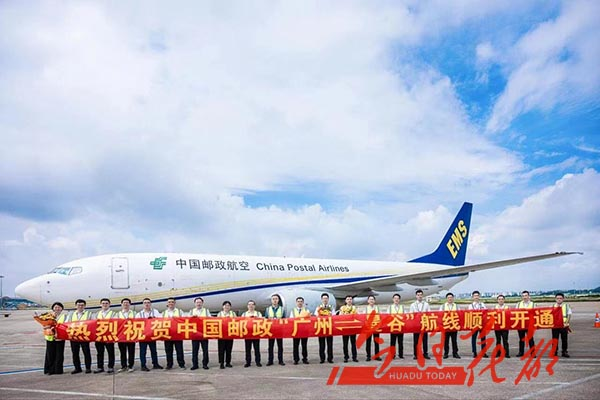
Riding the wave of RCEP policy benefits, electronics manufacturing, new energy, and cross-border e-commerce industries in the Guangdong-Hong Kong-Macao Greater Bay Area are expanding overseas with strong momentum, which has driven a sustained rise in demand among foreign trade enterprises for efficient, stable, and low-cost cross-border air logistics channels. At 10:57 a.m. on June 30, a B738 freighter fully loaded with 18 tons of cargo "Intelligently Made in the Greater Bay Area" took off from Guangzhou Baiyun International Airport, marking the official launch of Guangdong Post's "Guangzhou–Bangkok" international cargo route.
This route is operated by a subsidiary of Guangdong Post based in Huadu District. As the first operational one of the three cargo air routes to Southeast Asia that are planned and promoted with care by the Huadu District Airport Committee, based on the long-term layout of the District's airport economy, it will achieve localized and deep development of the air logistics industry, and be closely tied to Huadu's airport-based economic development layout.
Guangzhou-Thailand all-cargo direct flight in operation
builds high-frequency logistics channels to Southeast Asia
This route uses the B738 narrow-body all-cargo aircrafts, which, with a single-craft cargo capacity of about 18 tons, can carry various import and export goods such as cross-border e-commerce parcels, light industrial products, and electronic accessories. The route operates three round trips a week on Tuesday, Thursday, and Saturday. The high-frequency direct transport model eliminates the complicated multi-layered transit process, to significantly shorten cargo and mail transport time from the GHM Greater Bay Area to Thailand, effectively reducing logistics transfer losses and cross-border logistics costs for enterprises. The route enables two-way circulation, allowing daily necessities, smart devices, and e-commerce goods of China to reach Bangkok and then the Southeast Asian markets, while fresh produce, rubber, and light industry raw materials of Thailand can be quickly shipped back to China, supporting two-way trade connectivity between the two regions to achieve mutual benefit.
Relying on Huadu District's local cargo aircraft capacity advantage, foreign trade enterprises in the District can have access to nearby air logistics resources, enabling them to precisely seize market opportunities under the Regional Comprehensive Economic Partnership (RCEP), and further broaden the overseas expansion paths for goods "Intelligently Made in the Greater Bay Area”.
Coordinated efforts by both long and short routes
weave a close cross-border logistics network of land, sea, and air
The launch of the Bangkok route is a key move of Guangdong Post in implementing its strategic layout of "narrow-body aircrafts for Southeast Asia, and wide-body aircrafts for Europe and America." In terms of intercontinental route layout, Guangdong Post has in stable operation the "Guangzhou–Liège" freighter route with B777 wide-body planes, which operates regular flights once a week with an annual capacity exceeding 4,000 tons. Relying on Liège in Belgium as a transition hub, it enables goods from the Greater Bay Area to reach multiple countries in Western and Central Europe in 72 hours, establishing an ultra-fast air corridor that connects the Greater Bay Area and Europe.
Meanwhile, the Southeast Asia route matrix continues to expand. The District Airport Committee has planned to collaborate with enterprises to gradually launch two cargo routes: "Guangzhou–Ho Chi Minh City" and "Guangzhou–Kuala Lumpur,” which will also operate at high frequency with three flights per week. When that happens, the three Southeast Asia short routes will from with European intercontinental trunk routes a network that complement each other in freight capacity, enables dynamic capacity allocation, and fully covers the Indochina Peninsula, the Malay Archipelago, and core European markets. The synergistic advantage of integrating overland and air hub distribution resources across the region make it possible to flexibly adjust capacity according to enterprises' peak and off-peak seasons, which may effectively reduce air freight price fluctuations, significantly enhance the market bargaining power and core competitiveness of foreign trade enterprises in the Greater Bay Area, and help accelerate the formation of an independent cross-border dual-circulation air logistics network.
The launch of all three Southeast Asia dedicated routes will signify the beginning of a three-dimensional air cargo network that is operated in Huadu, connects Eurasia and further strengthens Huadu's position as the air logistics dispatch center in the region.
Huadu's airport-based economy is taking off
and the clustering effect of the aviation industry is taking shape
Closely focused on the goal of high-quality development, Huadu District has been cultivating the low-altitude economy and aerospace industry as key pillar industries during the 15th Five-Year Plan period. Relying on Baiyun International Airport and Chini General Airport, it is fully committed to building an aviation industry highland and a pilot zone for low-altitude economy in the northern of the Guangdong-Hong Kong-Macao Greater Bay Area.
With driving engines in both east and west, the industrial layout continues to optimize. In the eastern part an airport-based digital intelligence port is planned, which concentrates its attention on building platforms such as the aviation industry base, international fashion smart port, and airport-based pioneer digital intelligence port, with focus on core industries such as aviation manufacturing, aviation technology services, and air logistics, and is dedicated to creating a commanding height for innovation and development of the airport economy. And the low-altitude digital intelligence port in the west is focused on building platforms such as comprehensive base for aviation flight support and aerospace industrial park. The Grade B Chini general aviation airport is accelerating construction, which is equipped with facilities such as 1,000-meter test runway and large hangars in phase 1. The focus will be on developing aircraft R&D and manufacturing, low-altitude logistics, and other industries, striving to create a new engine for low-altitude industry in the north of Guangzhou.
Policies empower precisely, and the synergistic effect of platforms stands out. Huadu District has successively introduced a series of special policies to promote the development of air freight, low-altitude economy, and advanced manufacturing, providing precise support in the forms of project landing subsidies, route subsidies, and R&D rewards. At the same time, multiple national-level platforms, including the National Economic and Technological Development Zone, National Airport-based Economic Demonstration Zone, and Baiyun Airport Comprehensive Bonded Zone, are interacting to provide full-chain, one-stop service guarantees for the low-altitude economy and aerospace industry; as a result, the business environment and industrial ecosystem are improving continuously.
Clustered flagship projects contribute to steady rise of industrial capacity. Currently, flagship enterprises such as GAMECO, ST Aerospace, and Meihua Aviation are leading the development. Key enterprises like Terminal One, Zaiyi Superalloy, Airport Zhongtian Culture, and Yufei Aviation have successively settled in Huadu. The upstream and the downstream industrial chain are accelerating in coordination, and the industrial clustering effect is beginning to emerge, which injects strong momentum into the region's high-quality economic development.
Next, Huadu District will continue to deepen cooperation with Guangdong Post, and Guangdong Airport Authority, among others, accelerate negotiations and implementation of major projects related to aircraft maintenance, regional headquarters of airlines, and cargo freight branches, support aviation companies like GAMECO, ST Aerospace and Hangrun Technology in increasing capital and expanding production, continuously enrich the international route matrix, and continuously introduce localized air cargo projects, so as to continuously amplify the airport gateway advantage through the construction of a three-dimensional international air corridor, striving to build a new benchmark airport for opening up in the Guangdong-Hong Kong-Macao Greater Bay Area. Efforts will also be made to accelerate the development of the Airport-based Digital Intelligence Port, where the construction of Aviation Flight Support Base, Aerospace Industrial Park, Airport Economic Demonstration Zone Aviation Industry Base and other platforms will be sped up to provide solid carriers for industrial implementation. Relying on the combined advantages of national-level platforms, the District will provide full-chain service guarantees, with the view to push annual revenue of the airport economy over the threshold of 130 billion yuan.